Using AI to
Expand the Boundaries of Learning
PURWOKERTO — Bringing technology into the
classroom is not, by itself, enough to transform education in the age of
artificial intelligence (AI). Technology needs to be purposefully designed to
help students understand ideas, practise skills, solve problems, and become
more independent learners.
With this principle in mind, Elya Tati
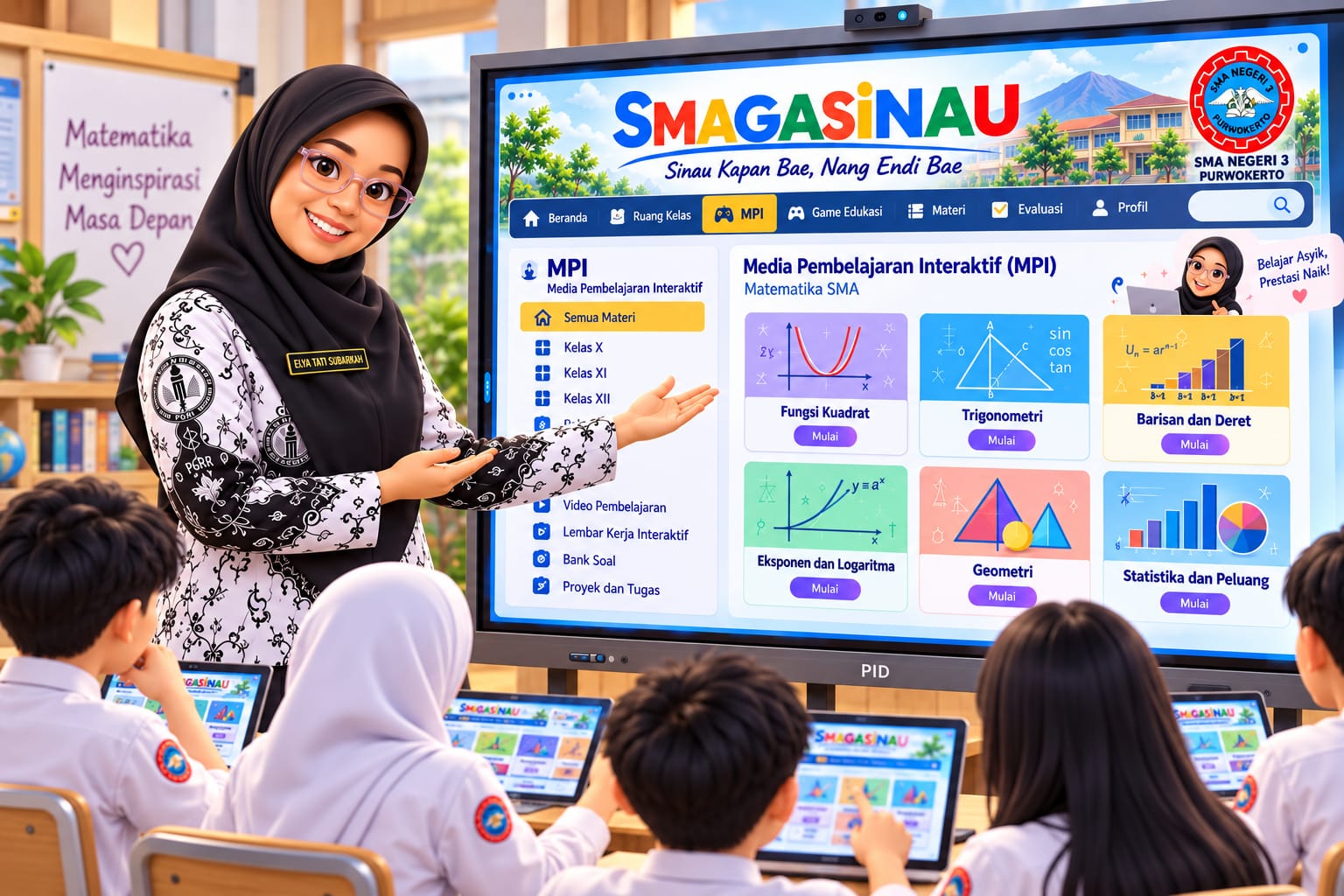
Subarkah, S.Pd., a Mathematics teacher at SMA Negeri 3 Purwokerto, developed
SMAGASINAU, a collaborative digital learning space. The initiative connects a
Classroom website, Interactive Learning Media (MPI), and educational games.
SMAGASINAU carries the Banyumasan tagline
“Sinau Kapan Bae, Nang Endi Bae,” meaning “Learn Anytime, Anywhere.” The
message is simple: learning should not end when the school bell rings or when
students leave the classroom. Learning materials should remain available so
that students can revisit them when needed and at a pace that suits them.
SMAGASINAU grew out of Elya’s experience
teaching Mathematics at SMA Negeri 3 Purwokerto. Her classroom practice
highlighted that making digital materials available is only one part of the
learning process. Students also need opportunities to explore concepts, test
their understanding, and practise actively.
For this reason, SMAGASINAU is conceived as
more than a website for storing teaching materials. It is an evolving ecosystem
that brings together learning resources, interactive media, educational games,
and technology-supported learning activities.
The Classroom website is available at
https://elyatatisubarkah.my.id/. It serves as the main access point where
students can find relevant materials. Interactive Learning Media and
educational games then offer additional ways to engage with the content.
SMAGASINAU is built around three core
components. Each serves a distinct purpose, while working in combination with
the others.
1.
Classroom website — a hub for learning resources. Students
can access topics when they need them and review materials beyond scheduled
lessons. Teachers can also organise resources so they are easier to locate and
use.
2.
Interactive Learning Media (MPI) — a space for exploring concepts. MPI encourages active participation. In Mathematics, interactive
activities can help students observe relationships between objects, try
different solution strategies, and build conceptual understanding through
guided exploration.
3.
Educational games — practice through challenges. Games
make practice more dynamic. Rather than only receiving information, students
answer questions, apply what they know, and check their understanding as they
work through challenges.
Together, these components can create a
connected learning sequence: students access the material, explore the
underlying concepts, practise through games, and then review their
understanding and learning progress.
As education continues to evolve,
SMAGASINAU is intended to develop further by incorporating artificial
intelligence and coding into digital learning activities.
AI could help students examine their
reasoning, receive guiding questions, check why an answer makes sense, and
reflect on their approach. The aim is to move beyond simply obtaining a final
answer and encourage students to understand the steps involved in solving a
problem.
Coding, meanwhile, can support the creation
of interactive media, game rules, question sequences, and feedback mechanisms.
In this way, technology can become part of the learning design itself, rather
than merely a digital display.
AI must nevertheless be used responsibly.
Its outputs need to be checked, students’ personal information must be
protected, and teachers should retain control over instructional decisions. AI
is a supporting tool—not a replacement for teachers or for students’ own
thinking.
One continuing challenge in Mathematics
education is helping students progress beyond memorising formulas towards
conceptual understanding, sound reasoning, and the ability to apply knowledge
to unfamiliar situations.
SMAGASINAU offers opportunities to connect
concept exploration, practice, problem-solving, and reflection. A teacher can
select materials aligned with the learning objectives, use MPI to clarify
ideas, and then use educational games to provide structured practice.
The next step is to evaluate the learning
process through assessments, observations of student participation, and learner
feedback. The success of an innovation should not be judged simply by the
number of materials or games available, but by evidence of changes in
understanding, engagement, and learning independence.
Impact measurement is therefore an
important part of SMAGASINAU’s ongoing development. Results from pre- and
post-assessments, student responses, classroom documentation, and teacher
reflections can help determine how effective the media are and what should be
improved next.
SMAGASINAU is not intended to serve only
one subject or one school. Its concept creates opportunities for teachers
across subjects and schools to collaborate, so that digital learning resources
can continue to grow and respond to learners’ needs.
Collaboration may include developing
materials, sharing effective practices, creating interactive media, and
designing educational games suited to students’ characteristics. With
thoughtful curation and management, the ecosystem could become a shared space
for knowledge exchange and educational innovation.
For the teaching community, SMAGASINAU also
illustrates that digital transformation does not always have to begin with a
complex system. Innovation can start with a real classroom challenge, develop
gradually, be tested in practice, and be refined in response to experience and
evidence.
Through SMAGASINAU, Elya Tati Subarkah,
S.Pd., seeks to make learning more open, interactive, and responsive to
technological change. The use of a Banyumasan identity in the tagline also
highlights how educational innovation can grow from a local community while
aiming to deliver broader benefits.
Looking ahead, SMAGASINAU will need
continued development through practical implementation, evaluation of learning
outcomes, documentation of effective practices, and collaboration with other
educators. These steps will help ensure that the ecosystem is not only
appealing as a technology initiative, but also demonstrates educational value
that can be shared and adapted elsewhere.
SMAGASINAU promotes the idea that learning
can happen anytime and anywhere. Through teacher collaboration, responsible
technology use, and student-centred learning, this initiative from Banyumas
aspires to contribute to the transformation of Indonesian education in the age
of AI.
Elya Tati Subarkah, S.Pd., is a Mathematics
teacher at SMA Negeri 3 Purwokerto and the initiator of SMAGASINAU. The digital
learning ecosystem connects a Classroom website, Interactive Learning Media,
and educational games.
Website:
https://elyatatisubarkah.my.id/
Tagline: “Sinau Kapan Bae, Nang Endi Bae” (“Learn Anytime, Anywhere”).